
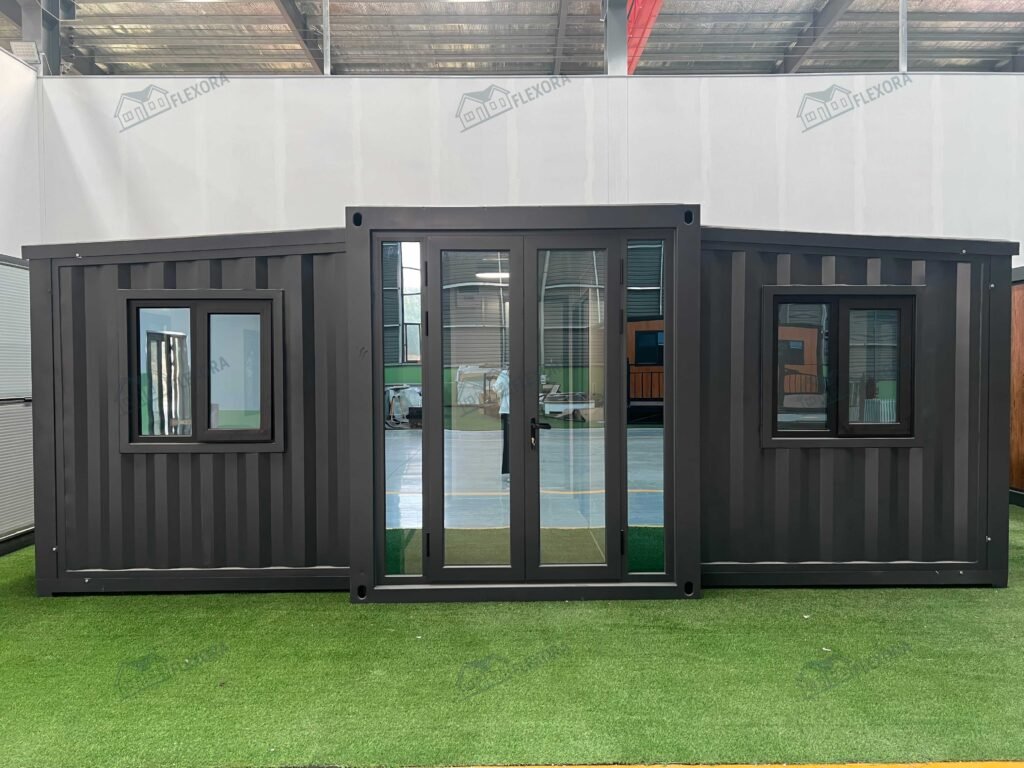
1. Structural Specifications for Disaster-Stricken Zones
In humanitarian crisis scenarios or extreme weather events (earthquakes, hurricanes, and floods), structural durability is vital for victim safety and emergency worker operations:
- Mechanical Unfolding Without Heavy Cranes: The butterfly-wing mechanical folding mechanism allows a crew to expand a $37\,\text{m}^2$ or $55\,\text{m}^2$ unit in 30 minutes using basic tools, making it ideal for areas with destroyed road infrastructure.
- Hygienic and Thermal Insulation Core: Constructed with waterproof Polyurethane (PU) or fireproof Rockwool sandwich panels, the walls are easily sanitized and maintain stable indoor temperatures across extreme spans from $-20^\circ\text{C}$ to $45^\circ\text{C}$.
- Anti-Seismic Structural Frame: Heavy-duty, hot-dip galvanized steel frames engineered to withstand seismic aftershocks up to Magnitude 8.0 and wind forces up to Grade 11.
2. Operational Applications in Crisis Management
A. Field Medical Clinics and First-Aid Outposts
Disaster relief modular housing units can be pre-fitted with medical-grade non-slip PVC flooring, pre-wired electrical systems, and LED lighting, ready for immediate use as triage centers, field pharmacies, or isolation wards.
B. Command Centers and Temporary Family Shelters
Each expandable unit can be partitioned internally to house 2 to 3 displaced families with privacy, or kept as an open-plan layout for government disaster coordination offices and humanitarian supply storage.
3. Supply Chain & B2B Logistics FAQ
How many disaster relief modular housing units fit in a single ocean container shipment?
Due to the mechanical folding compression, 2 fully equipped 20ft units or 1 fully equipped 30ft unit fit inside a single 40ft High Cube (40HQ) ocean shipping container, maximizing cargo density for rapid emergency dispatch.
Can the modular units be folded and reused after the crisis resolves?
Yes. The engineered folding system allows the entire structure to be collapsed in under 45 minutes without structural damage, enabling government agencies to store the units in strategic warehouses or redeploy them to new crisis locations.
Conclusion
Investing in disaster relief modular housing empowers government agencies, international NGOs, and disaster relief contractors to deploy critical shelter and healthcare facilities in record time.
At Flexora House, we manufacture certified expandable units engineered for rapid humanitarian deployment and global B2B logistics. Contact our special projects engineering team today to request institutional quotations and CAD floor plans.