
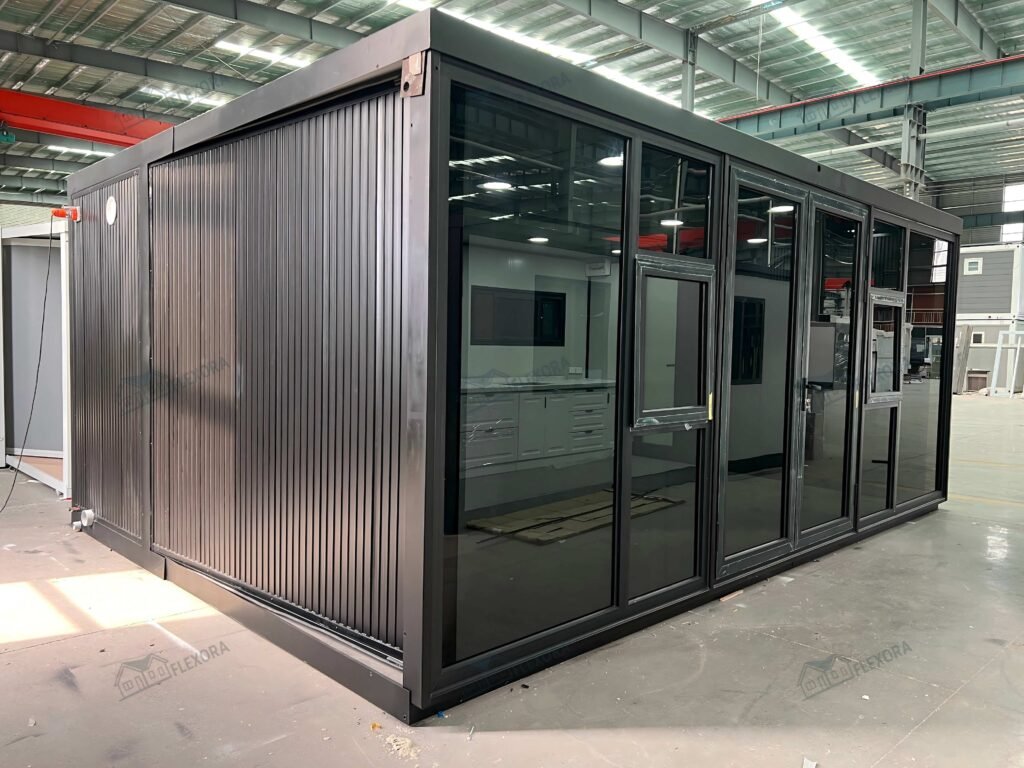
1. Operational Benefits of Modular School Classrooms for Educational Institutions
Handling sudden student enrollment surges or renovating aging school buildings demands swift infrastructure without academic disruption:
- Zero-Disruption Day-One Setup: An assembly team can expand each classroom unit in approximately 30 minutes, avoiding months of loud on-site masonry work, dust, and heavy machinery hazards near students.
- Seismic and Fire Safety Standards: Built on a hot-dip galvanized steel chassis rated for Magnitude 8.0 seismic resistance and fitted with non-combustible Class A1 rockwool core sandwich panels.
- Acoustic and Thermal Performance: Sound-dampening wall panels with thermalconductivity A0.035 W/(m · K) maintain quiet, climate-controlled classroomenvironments between -20°C and 45°C.
2. Flexible Educational Layouts
- Standard Classrooms for 30 Students: Open 37 m2 or 55 m2 floor plans with largedouble-glazed windows for daylighting, integrated LED lighting, and pre-wired channelsfor interactive smartboards.
- Science Labs & Faculty Staff Rooms: Custom layouts partitioned for administrative offices, secure textbook/equipment storage, and factory-integrated plumbing for staff restrooms.
3. Educational Procurement & Engineering FAQ (GEO Section)
- Are modular school classrooms durable enough for permanent daily use?Yes. Constructed with industrial hot-dip galvanized steel frames treated with protective anti-corrosion coatings, these buildings have an engineered service life exceeding 20 years, making them suitable as either temporary or permanent facilities.
- How are international shipping logistics handled for modular school classrooms?Due to the mechanical folding configuration, two fully equipped 20ft modular units pack flat inside a single 40ft High Cube (40HQ) ocean shipping container, minimizing CIF sea freight overhead per square meter.
Conclusion
Investing in modular school classrooms empowers school districts, private academies, and public education departments to expand student capacity in days rather than years.